
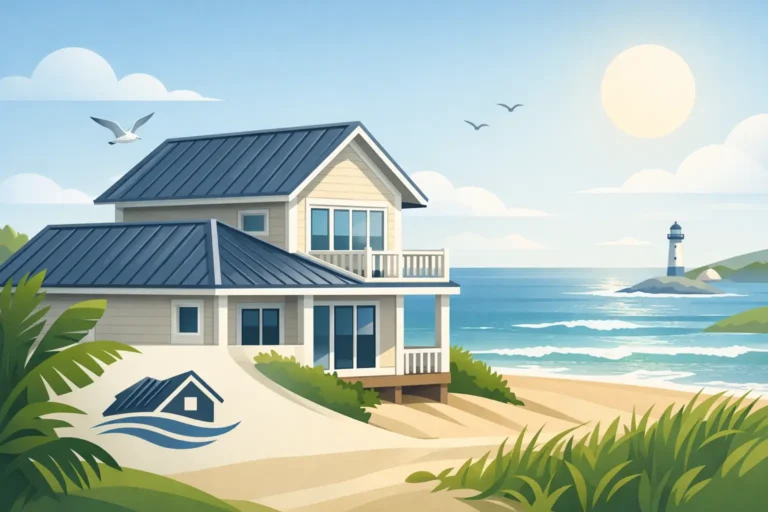
Salt air has a way of exposing weak points fast. A roof that performs well inland can struggle near the water, where wind-driven rain, humidity, and corrosion put every material to the test. That is why metal roofing for coastal homes gets so much attention from homeowners who want a roof built for long-term performance, not just a good first impression.
In coastal areas, roofing decisions are rarely just about appearance. They are about how a system holds up through storms, whether fasteners and flashings can resist corrosion, and how much maintenance a homeowner is taking on over the next 20 to 50 years. Metal can be an excellent fit, but only when the material, protective finish, and installation details are chosen with the environment in mind.
Why metal roofing for coastal homes makes sense
The main appeal of metal in a coastal setting is durability. A properly specified metal roof can perform very well against high winds, shed rain efficiently, and resist many of the moisture-related problems that shorten the life of other roofing materials. It is also lighter than many homeowners expect, which can be helpful when planning a replacement on an older structure.
Another advantage is longevity. In harsh coastal conditions, homeowners tend to think less about the cheapest option and more about what will still be performing after repeated storm seasons. A well-installed metal roof can offer that kind of value. It also tends to be attractive to property owners who want a cleaner, more durable finish with less vulnerability to curling, cracking, or water retention.
That said, not every metal roof is automatically a coastal roof. The difference is in the details. The wrong substrate, poor edge detailing, or low-grade fasteners can turn a premium-looking roof into a corrosion problem much sooner than expected.
The coastal challenge is not just wind
Many people assume the biggest threat near the ocean is storm damage. Wind is certainly part of the equation, but salt exposure is often the bigger long-term issue. Salt-laden air can accelerate corrosion on panels, screws, trims, flashing, and any exposed cut edges. Even small installation shortcuts become more serious in this environment.
Humidity also matters. Coastal homes often deal with prolonged moisture exposure, and that affects not only the roof covering but also the roof assembly underneath. Ventilation, underlayment choice, and moisture management all play a role in how well the system performs.
Then there is wind-driven rain. A roof in a coastal area needs to do more than shed vertical rainfall. It needs to resist water being pushed sideways and upward around joints, penetrations, and transitions. That is one reason panel profile, seam design, and flashing quality deserve close attention.
Best metal options for coastal properties
If you are considering metal roofing for coastal homes, material selection should come first. Aluminum is often one of the strongest choices in salt-heavy environments because it naturally resists rust. It can cost more than some alternatives, but for homes close to the shoreline, that premium may be justified.
Galvalume steel is another common option and can perform very well, especially when paired with a high-quality paint system designed for corrosion resistance. Still, distance from the water matters. A product that performs admirably a few miles inland may not be the best fit for a home directly exposed to salt spray.
Copper and zinc also perform well in the right settings, but they are generally chosen less often for standard residential projects because of cost and design preferences. For most homeowners, the practical decision usually comes down to aluminum versus coated steel, and that choice should be based on exposure level, budget, and expected lifespan.
The protective finish matters just as much as the base metal. Factory-applied coatings are not just cosmetic. They add a barrier between the metal and the coastal environment. Higher-end finishes typically provide better resistance to fading, chalking, and corrosion over time.
Standing seam vs. exposed fastener systems
This is one of the most important choices in a coastal roof replacement. Standing seam systems generally offer better long-term performance because the fasteners are concealed rather than exposed to the weather. That reduces direct exposure to moisture and salt, and it usually creates a cleaner path for water runoff.
Exposed fastener metal roofs can cost less upfront, but they often require more attention over time. The fastener points are more vulnerable, and in a coastal setting that can mean earlier maintenance or replacement concerns. Washers age, screws can back out, and every exposed penetration is another place where weather can start to win.
That does not mean exposed fastener systems are always the wrong choice. On some accessory structures or budget-driven projects, they can still make sense. But for a primary residence near the coast, many homeowners find that standing seam is the more dependable long-term investment.
Installation quality matters more near the ocean
A coastal roof is only as good as its installation. Even premium materials can underperform when panel layout is careless, flashing is undersized, or fasteners are mismatched to the environment. This is where contractor selection becomes just as important as product selection.
Proper installation starts with understanding the entire roof system, not just the visible panels. Underlayment needs to be suited to the climate. Flashings around chimneys, walls, skylights, and valleys must be carefully formed and sealed. Edge details must be designed to resist uplift. Ventilation needs to support the roof assembly so trapped moisture does not create problems from below.
Fastener choice is another area where shortcuts show up later. In coastal conditions, corrosion-resistant fasteners are essential. Mixing incompatible metals can also create avoidable issues. A roof should be installed as a coordinated system, with components that are intended to work together.
For homeowners, this is where certified installation practices and documented workmanship standards matter. A contractor with experience in demanding weather conditions is more likely to think through the details that protect the roof long after the crew has left the property.
What homeowners should expect for maintenance
One of the reasons people like metal is that it can be lower maintenance than many alternatives, but lower maintenance does not mean no maintenance. Coastal roofs benefit from periodic inspection, especially after major storms or winter weather.
Homeowners should expect to keep gutters clear, remove debris that can trap moisture, and watch for signs of coating wear, loose trim, or movement around penetrations. Rinsing salt residue may also be worthwhile in high-exposure locations, depending on the roof design and the manufacturer guidance.
The good news is that maintenance tends to be more manageable when the system was installed correctly to begin with. Problems on metal roofs are often less about the panel itself and more about neglected details like sealants, flashings, and fasteners.
Cost, value, and the long view
Metal roofing usually costs more upfront than standard asphalt shingles. That is often the main hesitation for homeowners. The better question, though, is what that cost buys you over time.
In a coastal environment, a roof that lasts longer, resists storm damage more effectively, and needs fewer repairs can offer very real value. The return is not only in service life. It is also in peace of mind, lower disruption, and confidence that the roof was built for the location rather than simply installed as a generic option.
There are trade-offs. If your budget is tight and the home has limited coastal exposure, a different roofing system may still be the right fit. If you plan to stay in the home long term, or your property faces constant wind and salt exposure, metal often becomes a much stronger candidate.
Is metal roofing right for every coastal home?
Not always. Roof shape, slope, surrounding tree cover, proximity to open water, and budget all influence the decision. Some homes are ideal candidates for metal. Others may need a broader conversation about ventilation upgrades, deck condition, or whether a premium asphalt system is more practical.
That is why an on-site assessment matters. A good roofing recommendation should reflect the actual property, not a one-size-fits-all sales pitch. At Companion Roofing, that means looking at the home, the exposure, and the long-term goals before recommending a system.
If you own a home near the coast, the smartest roofing decision is usually the one that respects the environment it has to endure. Metal can be an excellent answer, but only when the material, coating, and workmanship are all aligned with the conditions outside your front door.